Key Takeaways
- C9 bulbs measure roughly 1.5 inches in diameter and are the largest standard string-light bulb — their bold size makes them the go-to choice for roofline patriotic displays visible from the street.
- LED C9s run 70–80% cooler and use about 5 watts vs. 7–10 watts for incandescent, making them the smarter pick for season-long or repeated summer use in New York's humid July heat.
- Standard roofline spacing is 12 inches bulb-to-bulb; porch railings look best at 6–9 inches for a denser, more festive effect.
- A repeating red-white-blue-white-red sequence (2-1-2 pattern) gives colonial and ranch rooflines a balanced, flag-authentic look without the display feeling chaotic.
- New York's summer humidity — especially downstate — demands weatherproof sockets rated IP44 or higher and corrosion-resistant nickel contacts to prevent flickering and socket failure mid-celebration.
Drive through any Long Island neighborhood or Hudson Valley suburb on the Fourth of July and one thing stands out: the homes that stop traffic aren't draped in cheap plastic flags — they're outlined in glowing rows of red, white, and blue C9 bulbs that pulse against the summer dark like something out of a Macy's parade float. A well-executed C9 patriotic display is the residential lighting equivalent of a brass band: bold, unapologetic, and unmistakably American. But there's real craft behind the spectacle, and in New York — where a two-story colonial in Westchester faces different roofline geometry than a ranch in the Bronx, and where July humidity regularly tops 70% — getting the details right separates a display that dazzles from one that trips a breaker at 9 p.m. This guide covers everything you need to plan, install, and enjoy a patriotic C9 display that does your home proud.
What Makes a C9 Bulb Different — Size, Wattage, and Why It Matters
A C9 bulb is the largest bulb in the standard decorative string-light family, measuring approximately 1.5 inches in diameter and 2.25 inches tall, with an E17 intermediate base. That generous size is exactly what gives roofline displays their commanding street presence — C9s are clearly visible from 50 to 100 feet away, which matters enormously on a wide New York residential lot or a busy suburban street where smaller C7 or mini lights simply disappear into the landscape.
Wattage Comparison: Incandescent vs. LED C9 Bulbs
The wattage gap between incandescent and LED C9s is one of the most consequential choices you'll make for a patriotic display.
| Bulb Type | Wattage per Bulb | Heat Output | Lifespan | Best Use Case |
|---|---|---|---|---|
| Incandescent C9 (red/white/blue) | 7–10 watts | High (can burn fingers on contact) | 1,000–2,000 hours | One-night July 4th display, traditional warm glow preference |
| LED C9 (red/white/blue) | 4–5 watts | Low (safe to touch after hours of use) | 25,000–50,000 hours | Season-long summer display, repeated annual use, energy savings |
On a typical New York colonial with 120 feet of roofline using bulbs spaced 12 inches apart, you'd run approximately 120 C9s. At 7 watts each, that's 840 watts per string run — roughly 7 amps. A standard 15-amp circuit can handle that with room to spare, but add porch railing strands and you're approaching the safe 80% load threshold. LED C9s at 5 watts each pull only 600 watts total for the same 120-bulb run, giving you comfortable headroom to add railings, trees, or a flagpole wrap without flipping breakers. For homeowners planning a summer lighting countdown or keeping displays up from Memorial Day through Labor Day, LEDs pay back their price premium in energy savings within two to three seasons.
Humidity, Heat, and Hardware: What New York Summers Demand
New York's July heat and humidity — consistently 65–80% relative humidity downstate and nearly as humid in the Hudson Valley and Capital Region — create real risks for outdoor lighting hardware that homeowners often overlook until something fails mid-display.
Socket and Wire Ratings to Look For
- IP44 rating or higher: This weatherproof rating means sockets are protected against water splashing from any direction — essential for summer rain showers that arrive without warning.
- Nickel or brass contacts: Copper contacts corrode in humid air within one season; nickel-plated contacts resist oxidation and maintain reliable electrical contact through multiple July deployments.
- 18-gauge SPT-1 or SPT-2 wire: Heavier SPT-2 wire (with thicker insulation) handles summer heat expansion better and resists cracking on south-facing rooflines that bake in direct sun.
- Molded vs. zip-together sockets: Molded (watertight) sockets eliminate the gap where moisture infiltrates in zip-together designs — worth the extra cost for anything facing New York's Atlantic-influenced summer weather.
If you're also planning residential holiday lighting for the December season using the same C9 infrastructure, investing in quality hardware now means your patriotic display hardware does double duty all the way through Christmas — a smart way to amortize the cost of premium components.
Spacing Strategies: Rooflines vs. Porch Railings
Spacing is the single biggest variable in how a C9 display reads from the street, and the right interval differs significantly between rooflines and porch railings.
Roofline Spacing (12-Inch Standard)
For rooflines — whether you're outlining a peaked gable on a colonial or the straight horizontal run of a ranch — 12 inches between bulb centers is the industry standard. At this spacing, each bulb's glow blends slightly with its neighbors without creating hot spots or dark gaps, producing a continuous ribbon of color. On a colonial with two front-facing gables, plan the peak of each gable as a color-sequence anchor point so the pattern reads symmetrically from the street. Pre-spaced C9 string wire is widely available in 12-inch increments; avoid mixing spacing within a single run, as inconsistent gaps are immediately visible once the lights are on.
Porch Railing Spacing (6–9 Inches)
Porch railings are viewed from much closer than rooflines — often from 5 to 20 feet — so tighter spacing at 6 to 9 inches creates a denser, richer look appropriate for the scale. At 6 inches on a 30-foot front porch railing, you'll use approximately 60 bulbs; alternating red-white-blue at 6-inch spacing produces a tight, vibrant flag-color band that reads beautifully day and night. Wrap the railing posts themselves with a single strand of small-gauge wire holding just three to four bulbs each for a fully finished look on corner posts.
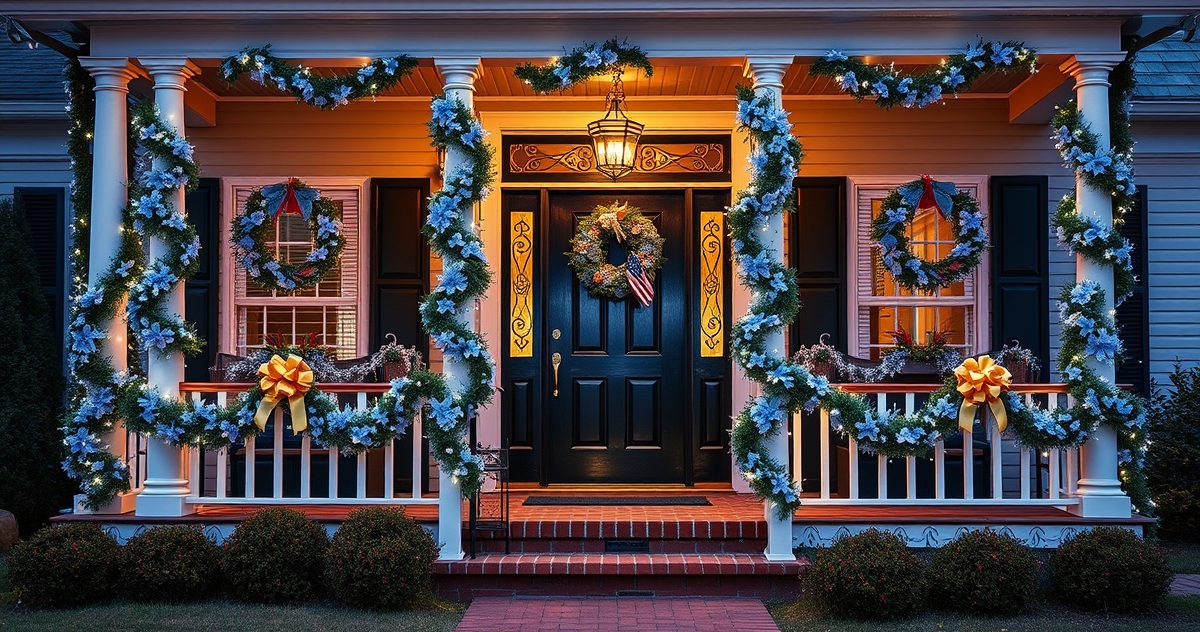
For ideas on blending C9s with other decorative elements, our post on garland accents for New York Tudor and colonial homes shows how layered textures complement a bold bulb outline — the same principle applies just as well in red, white, and blue for patriotic season.
The Red-White-Blue Sequence: Layout Diagrams for Colonial and Ranch Rooflines
The color sequence you choose determines whether your display reads as intentional and polished or random and busy. For patriotic displays, two sequences work best on New York residential rooflines.
The 2-1-2 Pattern (Colonial Rooflines)
This sequence — Red, Red, White, Blue, Blue — repeats every five bulbs and gives a balanced, flag-authentic rhythm that works beautifully on colonial homes with peaked gables. The double-color groupings read as bold bands of color from across the street while the single white between red and blue pairs acts as a visual separator that keeps the colors from muddying together.
- Start at one corner of the roofline with Red.
- Position bulbs: R – R – W – B – B (repeat).
- At each gable peak, plan for a White bulb so the apex is neutral — this prevents a color clash at the most visible point of the roofline.
- Mirror the sequence so both sides of the gable read symmetrically when viewed from the front.
- Finish the horizontal soffit run (if applicable) continuing the same R-R-W-B-B sequence for visual continuity.
The 1-1-1 Pattern (Ranch Rooflines)
Ranch homes have one long, horizontal roofline run — typically 40 to 80 feet — with no gable peaks to anchor. The simpler R-W-B repeating sequence (one bulb of each color) works perfectly here because the repetition rate is fast enough that the three-color stripe is clearly legible from the street without requiring viewers to mentally parse larger groupings. At 12-inch spacing on a 60-foot ranch roofline, a 1-1-1 sequence cycles exactly 20 complete R-W-B repetitions — a clean, satisfying mathematical regularity that professional installers appreciate.
Our detailed post on C9 roofline installations in Mount Vernon, NY explores how these same layout principles apply to holiday season displays — the geometry is identical whether your color palette is red-white-blue or traditional red-and-green.
LED vs. Incandescent C9s: Matching the Bulb to the Occasion
The LED versus incandescent decision should be driven by how long your display will run and how often you plan to reuse the equipment — not just upfront price.
One-Night July 4th Display
If your entire display runs for four to six hours on one evening, incandescent C9s are a perfectly reasonable choice. The total energy cost for a 120-bulb incandescent display running six hours is roughly $0.35–0.45 at New York's average residential electric rate of about $0.21/kWh — essentially negligible. The richer, warmer glow of incandescent white alongside the saturated red and blue is something many homeowners genuinely prefer for a single festive night. The trade-off is heat: incandescent C9s get hot enough that foliage contact is a fire risk, and on a 90°F July evening they add measurable warmth to socket hardware.
Season-Long or Multi-Holiday Use
For homeowners who want their patriotic display up from Memorial Day through Labor Day — or who plan to swap bulbs and reuse the same roofline infrastructure for permanent year-round lighting — LED C9s are the clear winner. Running 120 LED C9s for 150 hours across the summer season costs approximately $4.50 in electricity versus $12–15 for incandescent. LEDs maintain consistent color output without fading from heat, and their 25,000-hour lifespan means the same bulbs that light your July 4th celebration will be equally bright on New Year's Eve five years from now.
If you're planning summer displays alongside your holiday season calendar, our Christmas in July pricing preview covers how locking in installation rates during the summer off-season can save New York homeowners 15–20% compared to peak December booking.
Professional Installation vs. DIY: What to Know Before You Climb That Ladder
C9 roofline installation requires a ladder tall enough to reach eaves safely — on a two-story colonial, that typically means a 24- to 28-foot extension ladder. In New York, falls from ladders are the leading cause of DIY home improvement injuries. Beyond safety, professional installation adds precision: clips are placed at consistent intervals, sequences are color-checked before the strand goes up, and wiring is routed to avoid pinch points where insulation cracks over summer heat cycles.
Our residential lighting service handles everything from roofline layout planning to socket weatherproofing and post-season removal and storage — so your C9 hardware is protected from UV degradation and humidity during the off-months between July and the following summer. For commercial properties including storefronts, restaurants, and municipal buildings planning patriotic displays, our commercial team works at scale with the same attention to sequence and socket quality.
Curious about how we've executed large-scale C9 projects across the region? Our guides for Westchester estate lighting and Poughkeepsie roofline displays show the level of planning that goes into professional C9 installations on homes of varying sizes and architectural styles.
Frequently Asked Questions
What is the difference between a C9 and a C7 bulb for patriotic displays?
A C9 bulb is approximately 1.5 inches in diameter with an E17 base, while a C7 is about 1 inch in diameter with a smaller E12 base. C9s produce significantly more light output and are the better choice for roofline displays viewed from the street at 30 feet or more. C7s work well for close-up applications like window frames or porch columns where their smaller scale looks more refined. For a bold patriotic roofline statement on a New York colonial or ranch, C9 is the professional standard.
How many C9 bulbs do I need to outline my home's roofline?
Measure the total linear footage of the roofline you want to light — including both horizontal runs and any peaked gable edges — then divide by your chosen spacing in feet. At the standard 12-inch (1-foot) spacing, a 100-foot roofline requires 100 bulbs plus a few extras for sequence alignment. A typical 1,800-square-foot New York colonial with two front gables typically has 90 to 130 feet of visible front roofline, requiring 90 to 130 C9 bulbs. Always buy 10% extra to handle sequence adjustments and occasional bulb replacements.
Are LED C9 bulbs as bright as incandescent for outdoor patriotic displays?
Modern LED C9 bulbs produce comparable luminosity to incandescent versions — typically 0.5 to 1.0 lumens per LED bulb versus 5 to 10 lumens for incandescent, but because LEDs direct light more efficiently rather than radiating it in all directions, they appear comparably bright to observers at street distance. The color saturation of LED red and blue is actually more vivid than incandescent equivalents; the only area where incandescent holds a subtle edge is in warm white, where filament bulbs produce a creamier glow that some homeowners prefer for the white element of a patriotic sequence.
Can I leave C9 patriotic display lights up all summer in New York's humidity?
Yes, provided the hardware meets outdoor-rated standards. Look for IP44-rated or higher molded sockets, 18-gauge SPT-2 wire, and nickel or brass contacts. LED C9s are better suited for extended summer outdoor use than incandescents because they generate far less heat, reducing socket fatigue and insulation stress. If your display runs from Memorial Day through Labor Day — roughly 90 days — inspect sockets at the midpoint of the season for any signs of corrosion or moisture infiltration, particularly after extended rain periods common in New York's June and July.
What circuit capacity do I need for a full roofline C9 display?
For a 120-bulb LED C9 display at 5 watts per bulb, total draw is 600 watts — 5 amps on a 120-volt circuit. This leaves ample capacity on a standard 15-amp circuit (rated safe to 12 continuous amps per NEC guidelines) to add porch railing strands or a flagpole wrap. For incandescent C9s at 7–10 watts each, a 120-bulb run draws 840–1,200 watts (7–10 amps), which is manageable on a 15-amp circuit alone but leaves little headroom for additional loads. Never daisy-chain more than three to four C9 string sets end-to-end without consulting the manufacturer's run-length specifications.
Should I hire a professional to install C9 patriotic display lights on my New York home?
For single-story homes with accessible eaves, experienced DIYers with proper ladder safety equipment can handle C9 installation successfully. For two-story colonials, steeply pitched rooflines, or homes with finished landscaping where ladder placement is difficult, professional installation is strongly recommended. Professional installers work faster, ensure consistent spacing and color sequencing, route wiring safely away from heat sources, and use commercial-grade clips that won't damage shingles or gutters. They also handle removal and storage at season's end — protecting your hardware investment for years of reuse.